
Guwahati Municipal Corporation calls for responsible household waste disposal, encouraging residents to separate wet, dry,…
Tigress Spotted With Two Cubs in Kaziranga’s Kohora Range, Delight for Wildlife Lovers
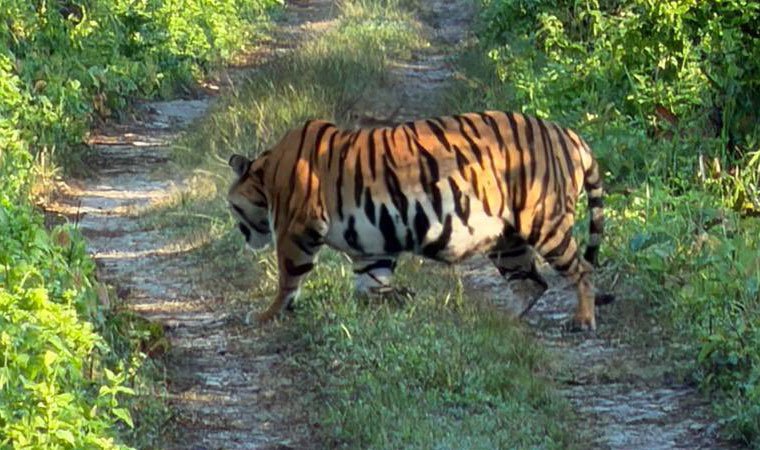 Kaziranga, Assam: A glimpse of a tiger family moving through the forests of Kaziranga National Park has become a talking point among wildlife enthusiasts, following reports of a Royal Bengal tigress being filmed alongside her two cubs in the park’s Kohora Range.
The reported sighting, said to have occurred during an afternoon wildlife safari, offers a fascinating look at the behaviour of one of India’s most iconic wild animals.
According to the account accompanying the footage, the mother tiger was seen moving along a forest trail as her two young cubs followed nearby.
The video has drawn interest not only because of the presence of the adult tigress but also because encounters involving young tiger cubs are relatively uncommon during regular tourist safaris.
Tigress and Cubs Reportedly Seen During Kaziranga Safari
The reported encounter unfolded along a mist-covered forest track in the Central Range of Kaziranga, commonly known as Kohora.
According to descriptions of the footage, the tigress moved through the vegetation while keeping her cubs close.
One of the cubs reportedly paused and looked towards the safari vehicle, while the other remained partly concealed among the surrounding plants.
The scene offered an unusual opportunity to observe the movements of a mother tiger and her offspring in their natural habitat.
Tigresses are generally protective of their young, particularly during the early stages of development when cubs depend on their mothers for food and security.
Such encounters also highlight the importance of maintaining a safe distance from wildlife and avoiding activities that could disturb animals.
Why Tiger Family Sightings Are Uncommon in Kaziranga
Although Kaziranga supports a significant population of Royal Bengal tigers, visitors cannot expect to encounter these elusive predators during every safari.
The national park features extensive grasslands, wetlands, woodland and dense vegetation that provide natural shelter for wildlife.
Tigers often remain concealed within these habitats, making sightings unpredictable even in areas with relatively high tiger densities.
Observing a mother accompanied by young cubs is particularly noteworthy because the animals may avoid exposed areas and human activity.
For wildlife photographers and safari visitors, witnessing such behaviour can provide a memorable glimpse into the lives of these powerful predators.
Kaziranga Records 148 Tigers in Wildlife Assessment
The reported sighting comes against the backdrop of Kaziranga’s growing importance as a major tiger conservation landscape.
According to the Status of Tigers in Kaziranga, 2024 assessment, released in July 2025, the tiger reserve recorded 148 adult tigers across its monitored divisions.
The previous assessment in 2022 had documented 104 tigers.
However, the higher total partly reflected the inclusion of the Biswanath Wildlife Division in the monitoring exercise for the first time.
The latest assessment also recorded a tiger density of approximately 18.65 animals per 100 square kilometres in the surveyed landscape.
The findings underline Kaziranga’s significance as a habitat for the endangered Royal Bengal tiger.
Importance of Protecting Tiger Cubs and Their Habitat
The presence of breeding females and young cubs is an important consideration in wildlife conservation.
Tiger cubs face numerous challenges during their early lives, including natural predators, food shortages, disease and possible disturbances within their habitat.
Their survival depends heavily on the protection provided by their mothers and the availability of suitable prey and undisturbed forest areas.
Kaziranga’s conservation efforts include habitat protection, anti-poaching patrols, wildlife monitoring and the management of areas important for animal movement.
Experts generally recommend that visitors avoid approaching, feeding or attempting to attract wild animals for photographs.
Responsible tourism is especially important when young animals are present because unnecessary disturbances can affect their natural behaviour.
Kaziranga Tourism Season Brings Visitors Back to Kohora
The reported sighting has attracted attention during Kaziranga’s 2026–27 tourism season.
The national park reopened for jeep safaris on October 3, 2026, following its annual monsoon closure. Elephant safari operations also resumed in early November.
Kohora is among the park’s principal tourism zones, attracting visitors interested in observing wild animals and exploring the diverse landscapes of Assam’s best-known national park.
While Kaziranga is internationally famous for its greater one-horned rhinoceros, it is also home to elephants, wild water buffalo, swamp deer, tigers and numerous bird species.
The rich variety of wildlife makes the UNESCO World Heritage Site one of India’s leading destinations for nature tourism.
Rare Wildlife Encounters Highlight Kaziranga’s Natural Heritage
The reported footage of the tigress and her cubs has once again brought attention to the extraordinary wildlife found within Kaziranga’s protected forests.
Although the precise date and original source of the video await independent confirmation, the described encounter illustrates why sightings of tiger families generate considerable interest among wildlife enthusiasts.
Kaziranga’s importance extends beyond individual wildlife sightings. Its grasslands, wetlands and forest habitats support a wide range of threatened species and contribute significantly to biodiversity conservation in Northeast India.
For visitors, encounters with wild animals remain unpredictable. For conservationists, protecting those animals and their natural habitats continues to be the greater priority.
Related Posts